Explore an Era:

Oligocene
38 - 24 million years ago
 Cooling trend |
 |
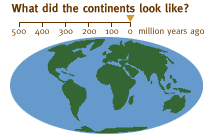
 Continents begin to take a modern shape |
|
 Broad leaf forests become common |
|
 Mammals begin to dominate |
|
 None |
 |
|
|
|
|
A cooling trend prevalent throughout the Oligocene period affected the lives and habitats of many organisms. In the oceans, marine life capable of withstanding cooler temperatures congregated to places further from the warmer equator. The cooling trend was also responsible for a reduced diversity in marine plankton, the foundation of the food chain.
On land, mammals such as horses, deer, camel, elephants, cats, dogs, and primates begin to dominate. Broad-leaved evergreen plants become increasingly confined to lower latitudes in Eurasia, and broad-leaved forest becomes common over large regions of the Northern Hemisphere.