Explore an Era:

Holocene
11,000 BC - Today
 Similar to today |
 |
 Similar to today |
|
 Abundance of edible berries and seeds |
|
 Great diversity of animals |
|
 Primarily native Americans; Europeans arrive |
|
 |
|
|
|
|
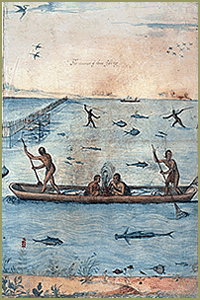
Watercolor by John White, "The manner of their fishing"
Click to enlarge image
Reproduced with permission from The British Museum
The Delaware Bay 1500 AD-1700 AD
The landscape of the 1500s was incredibly rich. Mixed wood forests were dominated by white
oak and were filled with abundant game-- deer, bear and beaver. The Bay was rich with waterfowl, oysters and fish.
Delaware's Native American Tribes
From archaeological evidence, we know that Delaware was populated by many settlements of Native American peoples by 1500. Their agriculture was limited-- they were primarily hunters and gatherers, dependent on the natural resources of their immediate surroundings. The first descriptions by the Europeans in the 1600s indicate they lived in domed huts made of bark or grass mats, laid over a framework of bent saplings. They regularly burned the woods to increase sunlight and encourage the browse loved by the deer they hunted. Whether they realized it or not, these burnings increased the abundance of edible berries and seeds and enhanced the fertility of the soil.
Evidence indicates that many of these tribes moved to the coastal areas during the summer, where they hunted and fished the abundant game. A watercolor by John White, illustrates three native methods of fishing. By day, they used a dip net and spear; by night, they lit a fire in canoes to attract the fish; and they used fish weirs (shown in the upper left) to attract fish. The watercolor shows pelicans, geese, ducks, sharks, sturgeon, skate and a horseshoe crab (in the lower right). It is the first known depiction of the horseshoe crab.
They were apparently skilled in crafts, making beautiful cups and other utensils from gourds; pieces of pottery and crude stone implements have also been found in old settlements on the peninsula.
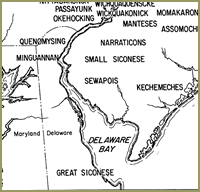
The Great Siconese (sometimes spelled Sickoneysinck) lived along the coast by the Delaware Bay. Their principal villages were downstream at Lewes, Delaware, near Cape Henlopen, where the
river widens to form Delaware Bay.
Map by Charlotte Carlson
The Leni Lenape
The tribes living in Delaware were the Leni Lenape, which was a division of the much larger Algonquin nation. After Captain Argall named the Bay after Lord de la Warr in the 1600s, the Lenape people living on the shores of the "de la Warr Bay" came to be known as the Delaware Indians.
Early maps by Europeans show that there were a large number of different sub-tribes, each with a different name, but speaking the same Algonquin tongue, with variations in dialect and pronunciation. A Dutch cartographer in 1629 describes them as having "a friendship altogether the one with the other, and are mostly one type of people and of one speech."
Conservative estimates of the size of the Delaware Indian population at the time the Europeans arrived place their number at about 8,000.
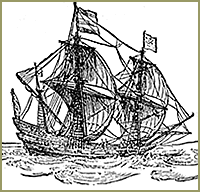
A contemporary sketch of Henry Hudson's dutchship, the "Half Moon", which first entered the Delaware Bay in 1609.
Arrival of the Europeans
The first Europeans to arrive in the Delaware Bay were Dutch explorers in the early 1600s. Their arrival, and the influx of Europeans that followed, were to have a profound effect on the Native American population. Most significant was the introduction of Old World diseases into the New World; these had a devastating effect on the native populations. By the end of the 1600s, disease and conflict had caused the death of almost 90% of the Indian population along North America's coast.
The other effect of the European arrival was the quick destruction of the ecology. Initially, the major impact was due to commerce. In Delaware, the wealth from the fur trade with the Europeans caused the Lenni Lenape to eradicate the bear and beaver population from their territory as early as 1644.
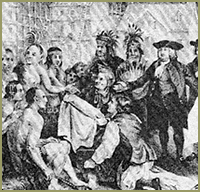
Detail of the engraving on the Penn Treaty of 1682. Signed by Penn as "Your Loving Friend'
Delawares Forced Out
In 1652, things began to change drastically for the Lenape following the granting of Pennsylvania to William Penn by Charles II. Penn realized that much of the land to which he had been given a royal charter was held by the Delaware (Leni Lenape) Indians. Although the document has not survived, it is believed that in 1682 Penn signed a treaty with the natives who occupied the land, paying them a fair value for its use by settlers. The first treaty document in existence is one dated July 15, 1682 in which Penn obtains land from Idquahon and several other Leni Lenape leaders.
Upon William Penn's death, another treaty was uncovered, selling part of the Leni Lenape homeland in what was known as The Walking Purchase Treaty of 1686. They then moved west to make room for the new settlers. Six more times they made treaties with the white men and, like it or not, sold their land and continued to move west until they moved for the 7th time to Oklahoma.