Explore an Era:

Holocene
11,000 BC - Today
 Similar to today |
 |
 Similar to today |
|
 Depletion of white oak forests for building |
|
 Diversity of birds, shellfish and animals decline |
|
 English population spreads |
|
 |
|
|
|
|
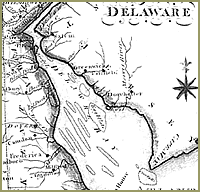
Detail of a 1795 map of the Bay shows many towns developing along the waterways.
Courtesy of the Corbit - Calloway Memorial Library, Odessa, Delaware.
English Settlements Expand
The English population spread along the banks of the estuaries. In Delaware, it moved southward along the shore of the Delaware River and Bay. In 1720, only a narrow ring of settlements were on the Eastern Shore of Maryland and the coast of Delaware Bay-- extending from Wilmington to Cape Henlopen and occupying the southern tip of the peninsula. Forty years later, this ring expanded several miles inland and moved down the coast south of Cape Henlopen.
The population expanded along waterways; the bays and rivers provided the only convenient means of transportation. There were few roads and they were described as "impassable after the least rain." The population of Delaware as recorded in the nation’s first census of 1790 was 60,000 equally divided among the 3 Delaware counties. By this time, all of the land on the peninsula had been claimed, although the interior was not populated until the railroads came.
Previous to 1872 there were no houses within 4 or 5 miles of Rehoboth Beach, which was a flat, wind-swept stretch of sand in front of a pine woods.
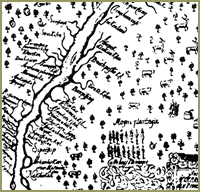
Detail of a map of the Delaware (circa 1654)by the Dutch explorer Lindestrom. From his "Geographia Americae"
The depletion of the forests
The first English on the peninsula felt their purpose as a colony was to send needed commodities to their mother country and many of these were natural resources of the land. England had depleted their own forests long ago and the supply on the peninsula seemed endless.
Maps made by early explorers of the Delaware Bay indicate a large number of trees (see map detail at left), but many species were soon depleted. The great forests of white oak were the first to go. It was used for the colonial shipbuilding industry that was actually thriving before 1700. The Delmarva oak was the choice on the eastern seaboard because the peninsula’s trees were taller, stouter and the wood firmer.
Decline in Soil Fertility
In the beginning of the 1700’s intensive planting of tobacco seriously depleted the soil. By 1750, corn and wheat were the principal cash crops planted and the soil was in serious condition. The farmers did not rotate their crops like they did in Europe. In 1841 James C. Booth, a professor at the Franklin Institute in Philadelphia, recommended the liberal use of marl, manure and other organic matter to improve Delmarva’s farmland. Lime was used, made from burned oyster shells or quarried limestone from the Pike Creek area near Newark, Delaware.
Horseshoe crabs, high in both lime and organic matter, were caught by the thousands when they came ashore to lay their eggs in the spring.